Why Your Cosmetic Business Doesn't Exist in AI Search (And What's Actually Broken)
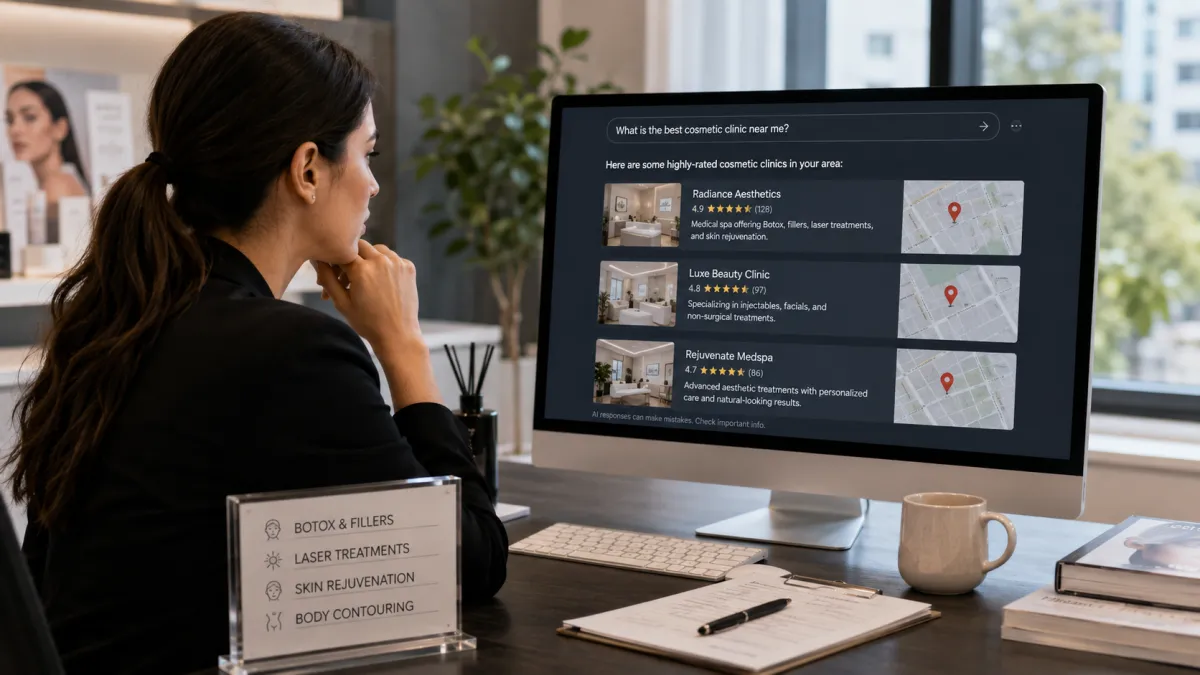
Your paid search is running. Your SEO looks polished. But when a potential client asks ChatGPT or Google's AI Overview for the best cosmetic clinic nearby, your business isn't part of the answer. That silence isn't a content problem. It's a structural one, and it's costing you clients you'll never know you lost.
Key Takeaways
AI engines cite businesses they can verify, not just businesses that rank well. The credibility signals they check are different from traditional SEO signals.
Inconsistent business information across directories creates entity ambiguity, and AI systems skip ambiguous businesses rather than risk a wrong recommendation.
FAQ schema is one of the fastest structural fixes for AI citation eligibility, and most cosmetic businesses don't have it deployed correctly.
A defined source of truth, meaning a single canonical reference for your brand name, services, and location data, is the foundation every other fix depends on.
Waiting to see how AI search develops isn't a neutral position. Every month a competitor is being cited in your place is a month they're building citation authority that makes them the default answer.
Why Does AI Search Skip Your Cosmetic Business Entirely?
The cosmetic industry invests heavily in visibility. Google Ads, Instagram, local SEO, influencer partnerships. The budgets are real. The intent is right.
But AI assistants don't work like search engines. Google ranks pages. AI engines synthesize answers from sources they trust enough to stake a recommendation on. Getting cited requires passing a credibility test that happens before a user types a single word.
That test is structural, not promotional.
AI systems check whether your business data is consistent, machine-readable, and unambiguous. Most cosmetic businesses fail that test without ever knowing it. No error message. No penalty flag. Just absence from answers that potential clients are actively acting on.
What Is a Technical AEO Foundation?
A technical AEO foundation is the underlying layer of structured data, entity signals, and verified business information that AI engines use to confirm your business is real, relevant, and trustworthy enough to cite.
Think of it this way: your service pages and blog content are your pitch. Your technical foundation is your credentials. AI engines check the credentials before they ever read the pitch.
The mistake most businesses make is investing entirely in the pitch while ignoring the credentials. You can publish the most detailed content on non-surgical rhinoplasty in your market, but if your schema markup is broken, your Google Business Profile doesn't match your website address, and your service descriptions read differently across platforms, an AI assistant will pass you over for a competitor whose technical foundation is clean.
Better content doesn't fix a broken technical foundation. More blog posts on top of a structurally invisible business just means more content that AI engines won't cite.
What Are the Five Technical Mistakes Keeping Cosmetic Businesses Out of AI Answers?
These aren't rare edge cases. They appear in cosmetic and aesthetic businesses at every level of digital sophistication.
Missing or Incomplete Entity Markup
Schema markup is the machine-readable language that tells AI engines exactly what your business is, what services it offers, where it operates, and how to categorize it. Without it, AI systems have to guess. And they'd rather skip you than guess wrong.
Consider a typical scenario: a medspa has a beautifully designed website with detailed service pages, but no schema markup deployed. When a user asks an AI assistant for the best lip filler clinic nearby, the AI can't confidently identify that business as a local cosmetic provider. Without properly structured LocalBusiness and MedicalClinic schema, the AI has no reliable signal to anchor that business to the query. A competitor with clean schema becomes the answer instead.
The fix isn't technically complicated. The reason it persists is that traditional web developers don't prioritize schema, and most marketing agencies haven't been trained in which schema types carry the most weight for AI citation purposes specifically.
NAP Inconsistency Across Directories
NAP stands for name, address, and phone number. It sounds elementary. It's inconsistent in the overwhelming majority of cases we encounter.
Your business name might appear as "Glow Aesthetics" on your website, "Glow Aesthetics Medspa" on Yelp, and "Glow Aesthetics LLC" on your Google Business Profile. To a human, that's obviously the same business. To an AI engine assembling a knowledge graph, those are three separate entities that can't be confidently reconciled.
Entity ambiguity is a citation killer. AI systems don't take risks on ambiguous data when they're generating answers that real people will act on.
No FAQ Schema Deployed
FAQ schema is structured markup that presents your questions and answers in a format AI engines can extract directly. It's one of the clearest signals that your content is answer-ready.
A common pattern: a cosmetic clinic has a well-written FAQ section on its Botox page, but the questions are plain HTML with no structured markup behind them. Because the AI can't cleanly extract those answers in a machine-readable format, it looks elsewhere for a source whose FAQ schema is properly implemented.
FAQ schema is one of the fastest single fixes for improving AI citation eligibility. In a high-consideration category like cosmetic services, where potential clients are asking AI assistants specific questions before they ever visit a website, this gap is particularly costly.
No Defined Source of Truth
A source of truth is a single canonical document that defines your business name, service descriptions, location data, and brand voice, used consistently across every platform, directory, and content asset you publish.
Without it, your business description reads differently on Google, on Yelp, on your website, and across your social profiles. AI engines weight consistency as a trust signal because it's how they determine whether two pieces of information are referring to the same entity. Inconsistency reads as unreliability, and unreliable sources don't get cited.
This is the mistake that makes every other fix harder. You can't build a credible entity profile on top of contradictory information.
Treating Your Google Business Profile as a One-Time Setup
Your Google Business Profile isn't a checkbox. AI systems, including Google's own AI Overviews, pull heavily from GBP data when generating local answers. Businesses that optimize their GBP for "near me" queries, with accurate service categories, updated photos, and structured Q&A responses, show up in AI-generated local results at a disproportionate rate.
Most cosmetic businesses set it up once and move on. That's a compounding disadvantage because competitors who keep theirs active are widening the gap every week.
What Does Fixing the Foundation Actually Change?
Why Do These Gaps Persist Even in Well-Run Businesses?
The reason technically sophisticated, high-spending cosmetic businesses have these gaps isn't negligence. It's category confusion.
Most cosmetic business owners and their marketing teams built their digital presence for traditional search, which rewards keyword density, backlinks, and page authority. Those signals still matter for Google rankings. They're largely beside the point for AI citation.
AI engines don't rank pages. They build knowledge graphs. The question they're answering isn't "which page is most authoritative?" It's "which business can I confidently recommend without getting it wrong?"
That's a fundamentally different question. It requires a fundamentally different answer.
What This Work Doesn't Solve on Its Own
Straight talk: a technical AEO foundation is necessary but not sufficient.
If your service pages have no substantive content, if your brand has no genuine authority signals in the market, or if your business has significant reputation problems in public review data, technical fixes alone won't make you the AI's top recommendation. Foundation work creates eligibility. Content quality and earned authority signals create preference.
The technical foundation is the floor, not the ceiling.
7 Questions Cosmetic Business Owners Ask About Technical AEO
Does my business need AEO work if my Google rankings are already strong?
Yes, and this is the most common false assumption in the category. Google rankings and AI citations are produced by different systems using different signals. A business can sit on page one for traditional search and be completely absent from AI-generated answers. The credibility requirements for AI citation are largely separate from traditional ranking factors, and one doesn't substitute for the other.
How long does it take for technical AEO fixes to show up in AI answers?
It depends on how fragmented your current data is and how quickly directory and schema changes are indexed and processed. There's no single timeline that applies to every business. What's consistent is that the citation position you build through a clean technical foundation is durable in a way paid placement isn't.
Can I just optimize my Google Business Profile and skip the rest?
GBP optimization matters, but it's one piece of a larger system. AI engines cross-reference multiple data sources to verify entity credibility. If your GBP is clean but your schema is broken and your NAP data is inconsistent across directories, you're still likely to be skipped. The five components work together, and a gap in any one of them can undermine the others.
Should my current SEO agency already be handling this?
Most traditional SEO agencies aren't trained in AEO-specific technical requirements because the category is genuinely new. An agency that's excellent at link building and keyword strategy may have no established process for AI citation optimization. It's worth asking your current agency directly what they're doing to improve your AI citation eligibility, not just your search rankings.
Why are cosmetic businesses particularly vulnerable to these gaps?
Cosmetic businesses operate in a high-trust, high-consideration category. When someone asks an AI assistant for a recommendation, the AI is cautious about citing businesses it can't cleanly verify. The combination of medical-adjacent services, strong local intent, and high consumer stakes means AI engines apply tighter credibility filters, which makes a clean technical foundation more important here than it would be in lower-stakes categories.
Does this work for multi-location cosmetic businesses?
Multi-location businesses have more to gain from technical AEO foundation work because the entity disambiguation problem multiplies with each location. Each location needs its own properly structured schema, its own verified NAP data, and its own active GBP optimization. Getting this right across all locations means appearing in AI citations across multiple markets simultaneously, which is a position that's genuinely hard for a single-location competitor to replicate.
What's the real risk of waiting to see how AI search develops?
Waiting feels like a neutral position. It isn't. AI engines build citation patterns over time, and businesses that establish early citation authority are meaningfully harder to displace than those trying to break in later. Every month a competitor is being cited in your category is a month they're reinforcing the exact citation habit you'll have to work against. The cost of inaction doesn't show up on a dashboard, but it accumulates.
AEOExpertly.com works with growth-minded cosmetic and professional service businesses across Southern California, the US, Australia, and Canada who want to claim their position in AI search before competitors do. If you want to know exactly where your technical AEO foundation stands, contact us to request a complimentary audit and get a prioritized picture of what's holding your business back.
About the Author
She Raj is the founder and lead strategist at Search Dominance Media and AEOExpertly.com. With 18 months of dedicated research and hands-on testing in Answer Engine Optimization, she's built one of the most research-grounded AEO methodologies available to professional service businesses. She works with growth-minded business owners and marketing leaders across the US, Australia, and Canada who are ready to lead in AI-generated search, not catch up to it.

