How the AEOExpertly AEO Readiness Audit Works: The Methodology Behind Every Fix
By She Raj
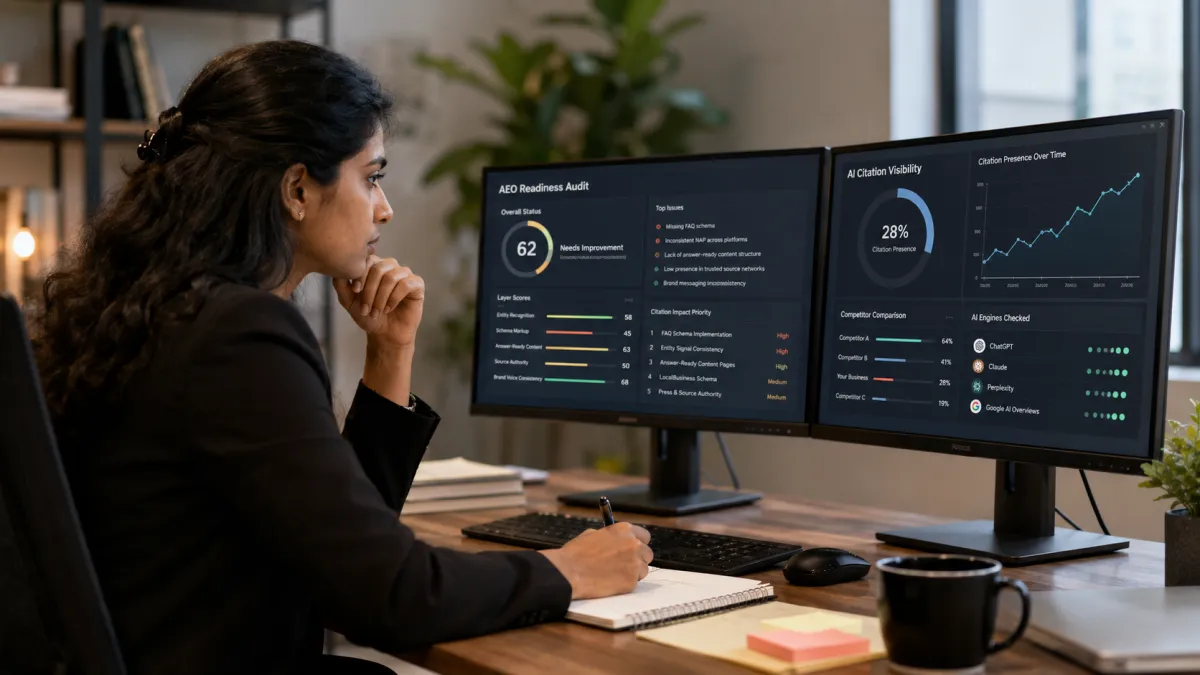
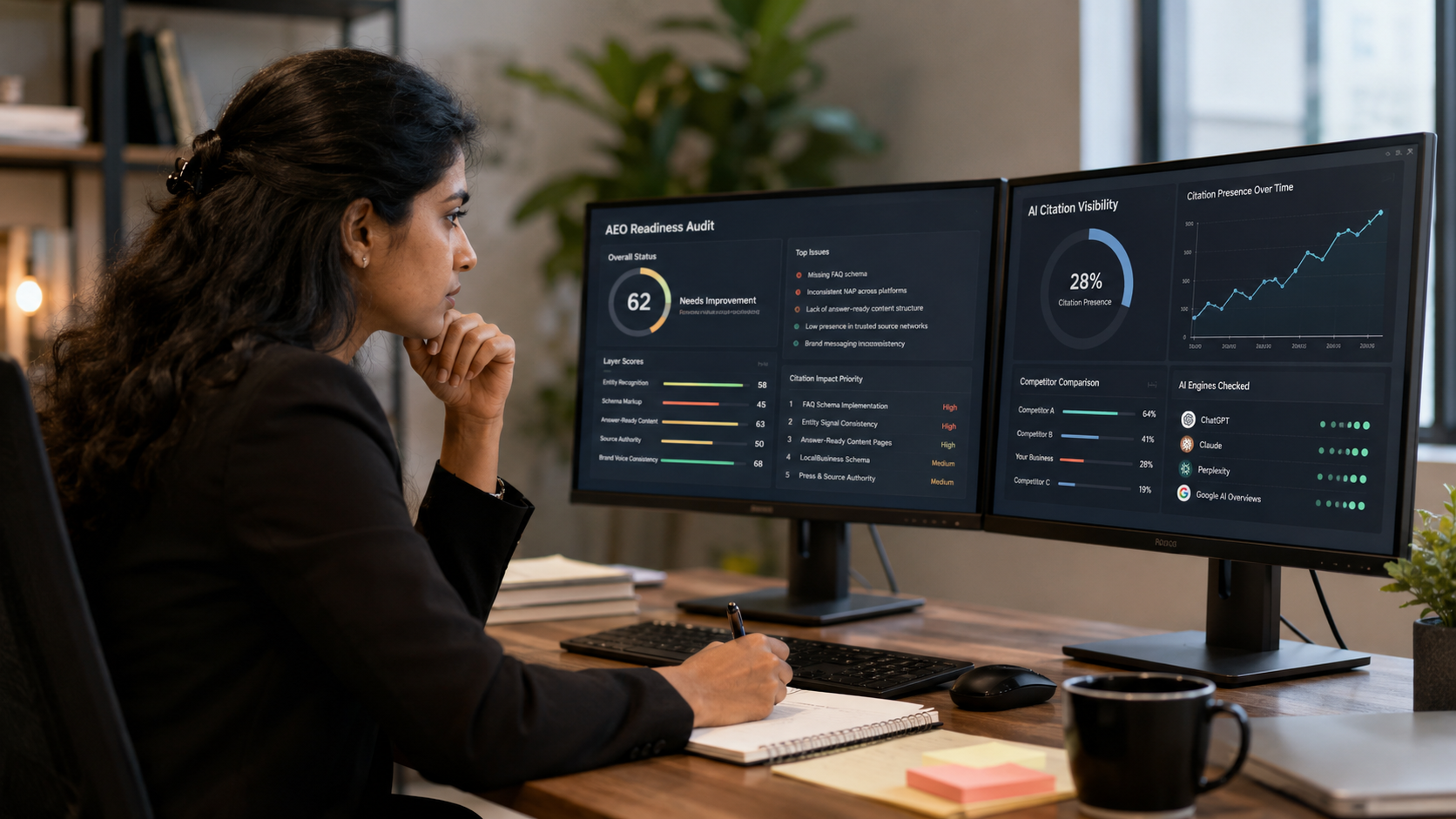
An AEO Readiness Audit is a structured diagnostic that identifies the specific gaps preventing AI assistants from citing your business in generated answers. It examines entity clarity, schema completeness, answer-ready content structure, source authority, and brand voice consistency. The output isn't a report. It's a ranked fix list ordered by citation impact.
Key Takeaways
AEO audits evaluate five distinct layers: entity recognition, schema markup, content structure, source authority, and brand voice consistency
Most businesses failing at AI citation have technically functional websites. The problem is structural, not cosmetic
A business with strong SEO rankings can be completely invisible in AI-generated answers because the two systems reward entirely different signals
AI engines don't reward the most authoritative brand. They reward the most answer-ready one
Waiting to see how AI search develops is the most expensive position you can take right now
Why Does a Technically Sound Website Still Get Ignored by AI?
Your site ranks on Google. Your PPC campaigns convert. Your brand is recognized in your market. And yet when someone asks ChatGPT or Claude to recommend a provider in your category, your name doesn't come up. A competitor you know you outperform does.
The reason isn't visibility. It's answerability.
AI engines don't crawl for rankings. They synthesize for answers. A page that performs well in traditional search can be completely invisible to an AI assistant if it isn't structured to respond to a specific question format. Large language models pull from content organized around direct questions and responses, supported by clear entity signals, and backed by source authority the model has already learned to trust.
Traditional SEO optimizes for click-through. AEO optimizes for citation. Those are different objectives. Solving the first one doesn't solve the second. These are genuinely separate problems, and the businesses that understand that early are the ones building citation presence while their competitors are still running SEO-only playbooks.
What Does the AEO Readiness Audit Actually Examine?
The AEO Readiness Audit is a five-layer diagnostic framework that evaluates every structural condition affecting whether an AI assistant will cite your business in a generated response.
Layer 1: Entity Recognition
AI engines build knowledge about businesses through entity signals, specifically your name, category, location, services, and the relationships between them. When those signals are inconsistent across your website, Google Business Profile, directory listings, and press mentions, the model treats your business as ambiguous. Ambiguous entities don't get cited. They get skipped in favor of a business whose signals tell a cleaner story.
Layer 2: Schema Markup Completeness
Schema is the structured data that tells AI crawlers exactly what your content means, not just what it says. Missing or incomplete schema is one of the most consistently surfaced technical gaps in service business diagnostics. A practice with no FAQ schema, no LocalBusiness markup, and no service schema is essentially asking AI engines to interpret context they weren't given. They won't interpret it in your favor.
Layer 3: Answer-Ready Content Structure
This is where most businesses fall short. Answer-ready content means your pages directly address the questions your customers are already asking AI assistants. Not in a general blog format. In a structured, extractable format, with a clear question, a direct answer in the opening lines, and supporting context a language model can compress into a citation. The businesses appearing in AI answers aren't necessarily publishing more content. They're publishing content built to be extracted.
Layer 4: Source Authority and Citation Chain
AI models weight sources they've encountered repeatedly across trusted contexts. This layer examines your backlink profile, press mentions, directory presence, and whether your brand appears in the kinds of sources AI engines treat as authoritative. A business with strong SEO authority but no presence in AI-trusted source networks is still invisible to citation engines. SEO authority and AI citation authority are two separate ecosystems, and building one doesn't automatically build the other.
Layer 5: Brand Voice and Source of Truth Consistency
If your website says one thing, your Google Business Profile says another, and your press releases say a third, AI engines can't build a coherent picture of what you do or who you serve. Consistency isn't a branding nicety. It's a citation prerequisite. The model has to be able to construct a single, confident answer about your business. Contradictory signals make that impossible.
How Does AEOExpertly.com Actually Run the Audit?
The audit process isn't a checklist handed off to a junior analyst. It's a structured diagnostic sequence built through dedicated AEO research and testing across service businesses, enterprises, and franchises.
Here's how it runs.
First, a baseline citation scan. The team queries multiple AI engines with the specific questions your customers are asking. This establishes your current citation footprint: where you appear, where you don't, and who's appearing instead of you.
Second, a gap analysis across all five layers. Every gap is documented with a specific diagnosis, not a category label. Not "schema issues." Specifically which schema types are missing, what questions they'd answer, and what citation opportunities they're currently blocking.
Third, a fix prioritization matrix. This is where the audit becomes a decision tool rather than a document. Fixes are ranked by citation impact, implementation speed, and competitive urgency. A business losing citation ground to a direct competitor in the same market gets a different priority order than one building from scratch. That distinction matters because the most impactful early fix for one business can be a low-priority item for another.
Fourth, a sequenced remediation plan. AEOExpertly.com delivers a specific, ordered list of fixes with clear ownership and clear sequencing. Not suggestions. A plan.
Consider what this typically surfaces for a high-revenue professional services business: the site performs well in traditional search, ad spend is active, and the design is polished. On the surface, the digital presence looks strong. But the five-layer diagnostic often surfaces something the standard SEO audit never catches. The structured data is thin or absent. The content answers general questions rather than the precise questions customers are asking AI assistants right now. And the entity signals across directories, the website, and the Google Business Profile are telling slightly different stories about who the business is and what it does. None of those gaps show up in a ranking report. All of them block AI citation. That's the operational specificity the audit is built to produce.
Isn't This Just SEO with a New Name?
No. The distinction is real and worth being precise about.
SEO optimizes your content to rank in a list of links. AEO optimizes your content to be extracted as an answer. The output of SEO success is a click. The output of AEO success is a citation, meaning your business name, your answer, and your authority appear inside the AI's response before the user ever decides to click anything.
Here's the part most businesses don't expect: a business with modest SEO rankings but strong AEO structure can outperform a dominant SEO player in AI-generated answers. AI engines don't pull from rank position. They pull from answer quality, entity clarity, and source trust. Those are different variables, and optimizing for one doesn't move the other.
There's a second tension worth naming. More content doesn't help without structure. Businesses that have published extensively without AEO architecture are sometimes harder to audit because there's more content working against them. Volume without structure creates noise. AI engines don't reward noise. They reward precision.
AEO Audit vs. Your Other Options: What the Decision Actually Costs
The cost of waiting isn't a future cost. It's compounding right now, every time a potential customer asks an AI assistant for a recommendation in your category and your name doesn't appear.
Who Gets the Most From an AEO Readiness Audit?
The audit delivers the sharpest results for businesses that already have a real digital presence and real marketing spend. If you're running PPC, investing in SEO, and operating at a scale where new customer acquisition has a clear dollar value, the audit gives you a precise picture of what's blocking a channel that's growing faster than any other right now.
It's built for businesses operating at scale, particularly in high-consideration categories where the customer is already using AI to research before they ever contact a provider. Cosmetics, professional services, health and wellness, and franchise operations all share that pattern.
One honest limitation worth stating: the audit requires something to diagnose. A business with no existing web presence, no content history, and no marketing infrastructure isn't starting with an AEO audit. That business is starting with a different conversation about building the foundation first. If that's your situation, AEOExpertly.com will tell you that directly.
On timelines: structural fixes take effect over weeks, not days. Citation presence builds as AI engines re-index and synthesize updated content. The most acute citation blockers can often be addressed first, which is why early fixes tend to show the clearest movement. A complete transformation of your AI presence takes longer, and anyone promising otherwise isn't being straight with you.
Frequently Asked Questions
How is an AEO audit different from an SEO audit?
An SEO audit examines factors that affect your ranking in traditional search results: page speed, backlinks, keyword usage, and technical crawlability. An AEO audit examines whether your content is structured to be extracted and cited by AI engines like ChatGPT, Claude, and Google AI Overviews. The two audits can surface completely different problems on the same website, and fixing one doesn't fix the other.
How long does the audit process take?
The diagnostic phase typically runs one to two weeks depending on the size and complexity of your digital presence. The sequenced remediation plan is delivered at the end of that process with a clear implementation order, so your team or AEOExpertly.com's team can begin fixes immediately.
Will AEO fixes hurt my existing SEO rankings?
The structural changes that improve AI citation are generally neutral or positive for traditional SEO. Schema additions, entity consistency improvements, and answer-ready content structure don't conflict with ranking signals. In many cases they reinforce them, because the underlying principle of making your content clear and authoritative applies to both systems.
What if my competitors have already started AEO optimization?
Then the audit becomes more urgent, not less. The audit includes a competitive citation scan that shows where competitors are appearing in AI answers and what structural advantages they've built. That analysis directly informs the priority order of your fix list. Knowing where you're losing ground is the prerequisite to closing the gap.
Do I need to rebuild my website to implement the fixes?
In most cases, no. The majority of AEO fixes are content structure changes, schema additions, and entity signal corrections that don't require redesigning or rebuilding your site. Some fixes involve your Google Business Profile, directory listings, or press presence rather than your website at all.
How does AEOExpertly.com measure whether the fixes are working?
The same baseline citation scan used at the start of the audit is repeated after implementation. The team queries the same AI engines with the same customer questions and tracks whether your business appears in the generated answers. Citation presence is the metric, not ranking position. You can see the shift clearly because the starting point was documented.
Is AEO relevant for businesses outside the US?
Yes. AI assistants like ChatGPT and Claude operate globally, and the citation mechanisms they use don't change by geography. AEOExpertly.com works with businesses across the US, Australia, and Canada. Local entity signals and regional source authority factor into the audit, which is why geographic consistency in your digital presence matters regardless of where you operate.
The window for first-mover advantage in AI citation is open right now. It won't stay open. Contact AEOExpertly.com to find out exactly what's standing between your business and the AI citations your competitors are working toward.
About the Author
She Raj is the founder and lead strategist at Search Dominance Media and the principal voice behind AEOExpertly.com. She specializes in Answer Engine Optimization, AI visibility strategy, and helping growth-stage businesses build citation presence in AI-generated search across the US, Australia, and Canada.

